True False Not Given: IELTS Reading Practice Lessons
Free practice reading for IELTS True False Not Given questions. IELTS reading TFNG questions come in both the Academic reading test and the General Training reading test. Below are 4 FREE practice lessons for IELTS TFNG questions. They are practice lessons for IELTS candidates and are aimed at helping people develop awareness and skills to successfully tackle these types of reading questions.
TFNG Reading: Exercise 1
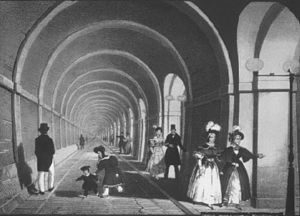
Passage: The Thames Tunnel
The Thames Tunnel was a tunnel built under the River Thames in London. It was the first subaqueous tunnel ever built and many people exaggeratedly claimed it was the Eighth Wonder of the World at the time it was opened. It was opened in 1843 to pedestrians only and people came from far and wide to see the marvel. The day it was first opened, it attracted five thousand people to enter the tunnel and walk its length of almost 400 metres. The Thames Tunnel was used by people from all classes. The working class used it for its functional use of crossing from one side of the river to another, while for the middle classes and upper classes, it was a tourist experience. In the age of sail and horse-drawn coaches, people travelled a long way to visit the tunnel, but this was not enough to make the tunnel a financial success. It had cost over £500,000 to complete which in those days was a considerable amount of money. However, even though it attracted about 2 million people each year, each person only paid a penny to use it. The aim had been for the tunnel to be used by wheeled vehicles to transport cargo so that it could bring in a profit. But this failed and the tunnel eventually became nothing more than a tourist attraction selling souvenirs. In 1865, the tunnel became part of the London Underground railway system which continues to be its use today.
Questions 1-8
Are the following statements true, false or not given according to the information in the passage?
- True = the statement matches the information in the passage.
- False = the statement contradicts the information in the passage.
- Not Given = the information is not found in the passage.
- The Thames Tunnel was the first tunnel ever built under a river.
- The Thames Tunnel was the Eighth Wonder of the World.
- People were drawn from all over to see the Thames Tunnel.
- The tunnel was used more by the middle and upper classes.
- People were able to travel by sea or land in those days.
- The aim of the tunnel was to turn a profit as a tourist attraction.
- Statues of the tunnel could be bought as souvenirs.
- The tunnel is no longer used as a pedestrian walkway to cross the river.
Click below to reveal the answers:
- TRUE
- “It was the first subaqueous tunnel ever built… “
- You might not know the word “subaqueous” but I’m sure you are familiar with “subway” which means a way under the ground. You might also recognise the word “aqua” as being connected with water. Even if you don’t know words, you can make an educated guess about the answer.
- FALSE
- “…many believed it was the Eighth Wonder of the World at the time…… “
- It was something people believed at that time. It was not a fact.
- TRUE
- “…drew people from far and wide…”
- The word “draw” in this context means to attract.
- “from all over” is an expression which does not mean from every individual country in the world. It is a vague expression – from many places.
- NOT GIVEN
- The passage does not state how much each class used the tunnel.
- TRUE
- “In the age of sail and horse-drawn coaches….”
- “sail” refers to boats (sea) and “horse-drawn coaches” were the method of land travel.
- FALSE
- “The aim had been for the tunnel to be used by wheeled vehicles to transport cargo so that it could bring in a profit.”
- NOT GIVEN
- There is no information about what types of souvenirs were sold.
- TRUE
- “In 1865, the tunnel became part of the London Underground system which continues to be its use today.”
.
TFNG Reading: Exercise 2
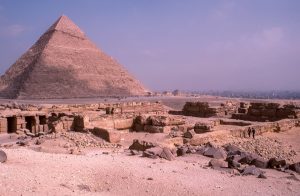
Passage: Pyramid Building
The most famous pyramid is the Great Pyramid of Giza which is actually only one of over a hundred surviving pyramids. There is a long-standing question about how the pyramids were built given the lack of technology over 4,000 years ago but scientists are piecing together the puzzle. The blocks which make up the pyramids were hewn from quarries and then transported to the pyramids for construction. This was an incredible feat considering the distance that the raw materials had to travel and their enormous weight. The transportation of the materials was either by river using a boat or by land using a wooden sledge. Given the softness of the ground, the wheel would have been of little use had it been invented at that time. It is believed that the sand in front of the sledge was wet with water in order to facilitate the movement of the sledge and reduce friction. These sledges were pulled manually or sometimes by using beasts of burden depending on the ease at which the sledges could move over the ground. Interestingly, two thousand years after the pyramid building era of the Ancient Egyptians, the Romans moved stones using similar techniques at Baalbek. Once the blocks arrived at the pyramid construction site, it is thought they were moved into place using a ramp and pulley system.
The Old Kingdom period in Ancient Egyptian history is also known as the pyramid building era. The Ancient Egyptians achieved the most remarkable feats of building work which have still not been surpassed, particularly given the primitive technology used to build them. There is nothing remotely mystical or magical about how the pyramids were built as is commonly thought. Further still, while popular belief is that the Great Pyramid was built using slave labour, this theory has since been debunked. The first building made in a pyramid shape is thought to be the Stepped Pyramid which consists of six steps placed on top of each other in a pyramid shape to create the world’s first superstructure. The credit to finally achieving a smooth sided pyramid goes to Imhotep, an architect commissioned by King Sneferu. The pyramids were not an instant achievement, but the achievement of trial and error.
Questions 1-9
Decide if the statements below are True, False or Not Given according to the information in the passage.
- The controversy over the method used in the construction of the pyramids has been solved by scientists.
- It is possible that Ancient Egyptians could have lubricated paths to aid transportation by sledge.
- Sleds were dragged by animals not humans.
- The Romans learned the techniques of moving huge stones from the Ancient Egyptians.
- The building work of the Ancient Egyptians is unrivalled.
- Many people believe that magic may have been used by the Ancient Egyptians to build the pyramids.
- The Great Pyramid was built using slave labour.
- It took more than one attempt to get the construction of the pyramids right.
Note: Photo by Les Anderson
Click below to reveal the answers:
- FALSE
- “…scientists are piecing together the puzzle.” = currently – a work in progress – not finished.
- TRUE
- “It is believed that the sand in front of the sledge was wet with water in order to facilitate the movement of the sledges and reduce friction.”
- FALSE
- “These sledges were pulled manually or sometimes by using beasts of burden …”
- manually = by hand (people)
- beast of burden = animal
- Not Given
- The passage gives no information about who the Roman’s learned from.
- “…using similar techniques at Baalbek”. The preposition “at” means that “Baalbek” is a place, not a person.
- TRUE
- “The Ancient Egyptians achieved the most remarkable feats of building work which have still not been surpassed ….”
- TRUE
- “There is nothing remotely mystical or magical about how the pyramids were built as is commonly thought. “
- Meaning: “There is nothing magical – as is commonly thought.
- Meaning: “There is nothing magical but many people think there is.”
- The term “as is commonly thought” changes the whole meaning of the sentence given and converts it to the meaning above. This is high level English. If you get this question wrong, it is due to language, not technique.
- If you struggle to understand this one, you might need to ask an English language teacher to give you a lesson on the use of this expression.
- FALSE
- “…while popular belief is that the Great Pyramid was built using slave labour, this theory has since been debunked.”
- debunked = discredited
- TRUE
- “The pyramids were not an instant achievement, but the achievement of trial and error.”
.
TFNG Reading: Exercise 3

Passage: Beethoven
Composer Ludwig van Beethoven was born on or near December 16, 1770, in Bonn, Germany. He is widely considered the greatest composer of all time. Sometime between the births of his two younger brothers, Beethoven’s father began teaching him music with an extraordinary rigour and brutality that affected him for the rest of his life. On a near daily basis, Beethoven was flogged, locked in the cellar and deprived of sleep for extra hours of practice. He studied the violin and clavier with his father as well as taking additional lessons from organists around town. Beethoven was a prodigiously talented musician from his earliest days and displayed flashes of the creative imagination that would eventually reach farther than any composer’s before or since.
In 1804, only weeks after Napoleon proclaimed himself Emperor, Beethoven debuted his Symphony No. 3 in Napoleon’s honor. It was his grandest and most original work to date — so unlike anything heard before that through weeks of rehearsal, the musicians could not figure out how to play it. At the same time as he was composing these great and immortal works, Beethoven was struggling to come to terms with a shocking and terrible fact, one that he tried desperately to conceal. He was going deaf. At the turn of the century, Beethoven struggled to make out the words spoken to him in conversation.
Despite his extraordinary output of beautiful music, Beethoven was frequently miserable throughout his adult life. Beethoven died on March 26, 1827, at the age of 56.
Questions 1 – 8
Are the following statements True, False or Not Given according to the information in the passage.
- It is not known exactly when Beethoven was born.
- Beethoven suffered cruelty at the hands of his father.
- Beethoven was denied hours of sleep as a punishment for poor performance.
- Beethoven’s father was also a talented musician.
- Beethoven’s Symphony No. 3 was inspired by a famous man.
- In the early 1800’s Beethoven struggled to follow a conversation.
Click below to reveal the answers:
- True
- True
- False
- Not Given
- Not Given
- The main problem people have with this question is the word “inspire”. The word “inspire” and the words “in someone’s honor” are not at all the same. They have a completely different meaning. Check an online dictionary to find out.
- True
.
TFNG Reading Exercise 4
Passage: Spam Messaging
SPAM, as every user of mobile phones in China is aware to their intense annoyance, is a roaring trade in China. Its delivery-men drive through residential neighbourhoods in “text-messaging cars”, with illegal but easy-to-buy gadgetry they use to hijack links between mobile-phone users and nearby communications masts. They then target the numbers they harvest, blasting them with spam text messages before driving away. Mobile-phone users usually see only the wearisome results: another sprinkling of spam messages offering deals on flats, investment advice and dodgy receipts for tax purposes.
Chinese mobile-users get more spam text messages than their counterparts anywhere else in the world. They received slightly more than 300 billion of them in 2013, or close to one a day for each person using a mobile phone. Users in bigger markets like Beijing and Shanghai receive two a day, or more than 700 annually, accounting for perhaps one-fifth to one-third of all texts. Americans, by comparison, received an estimated 4.5 billion junk messages in 2011, or fewer than 20 per mobile-user for the year—out of a total of more than two trillion text messages sent.
Questions 1-7
Decide if the following questions are true, false or not given.
- In China, SPAM text messaging is a successful business.
- People’s phone numbers are collected through the use of technology which cannot be readily bought.
- In no other country do people receive more Spam texts than in China.
- In 2013, the number of SPAM texts increased considerably to reach at least 300 billion.
- The majority of all texts received in Shanghai and Beijing are SPAM.
- In 2011, Americans sent more texts than anywhere else in the world.
Click below to reveal the answers:
- True
- roaring trade
- False
- the gadgetry = technology
- easy to buy = readily bought
- This is false because the passage shows it is easy to buy which contradicts the statement.
- True
- Not Given
- Most people get this question wrong because they don’t pay attention to meaning. The passage only gives one fixed number in time = over 300 billion. “Over 300 billion” means “more than 300 billion”, it does not indicate an increase or a decrease.
- False
- only one third are SPAM at the most
- Not Given
Vocab Builder
- intense = strong / extreme
- roaring business = successful business / booming business
- residential = suburban
- gadget = device
- harvest information = collect / gather
- sprinkling = smattering
- counterparts = equals / colleagues
- spam messages = junk messages
- digits = numbers / numerals